
Hidden Indian Espionage Network for Israel in the Region: of Extensive Intelligence Operations in Iraq and Iran
Des rapports publiés ont révélé l'activité importante de citoyens indiens en Irak et en Iran, qui espionnaient pour Israël.
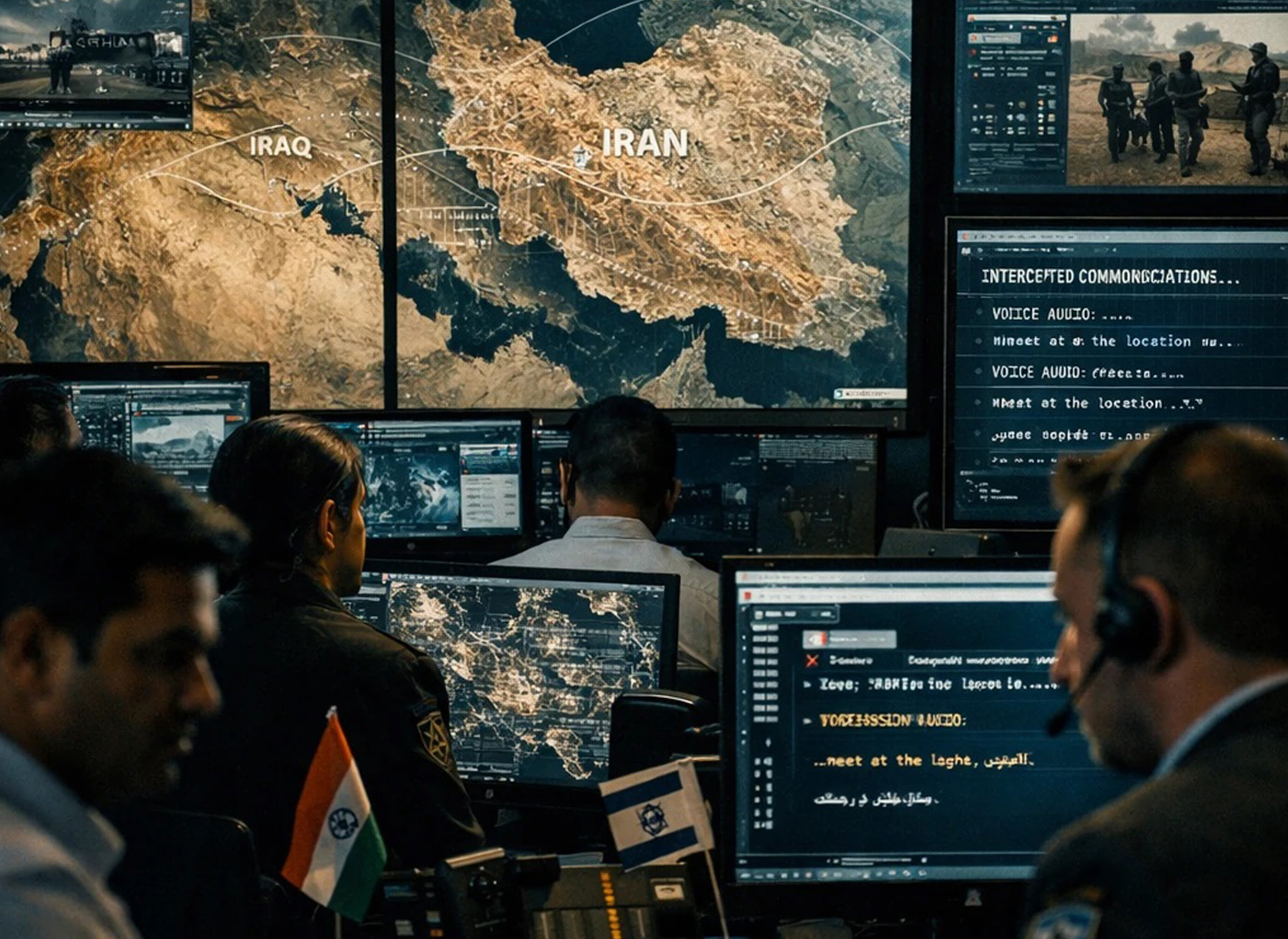
ISLAMABAD — Pakistani media outlet Ummat News, citing international political and security analyst Muhannad Salloumi, has reported allegations of extensive intelligence-gathering activities by Indian nationals in Iraq on behalf of Israel.
Salloumi, a visiting professor in the Security Studies Programme at Doha University and a member of the editorial board of the Journal of Strategic Studies, stated during a television programme in Qatar that approximately 1.5 million Indian nationals were working in various sectors across Iraq, including healthcare, the Iraqi military and even municipal services and sanitation, while allegedly conducting intelligence activities in Israel’s favour.

According to the analyst, Israel exploited Iraq’s perception of India as a friendly country, using that trust as an opportunity to establish extensive intelligence penetration. He further claimed that these activities ultimately aimed to secure military and weapons superiority for India against Pakistan, although, in his assessment, the effort failed to achieve its ultimate objectives.
Pakistani Journalist’s Post Draws Media Attention
Ahmad Bhatti, a journalist with Pakistan’s Dunya News television network, addressed the allegations in an English-language post on X.
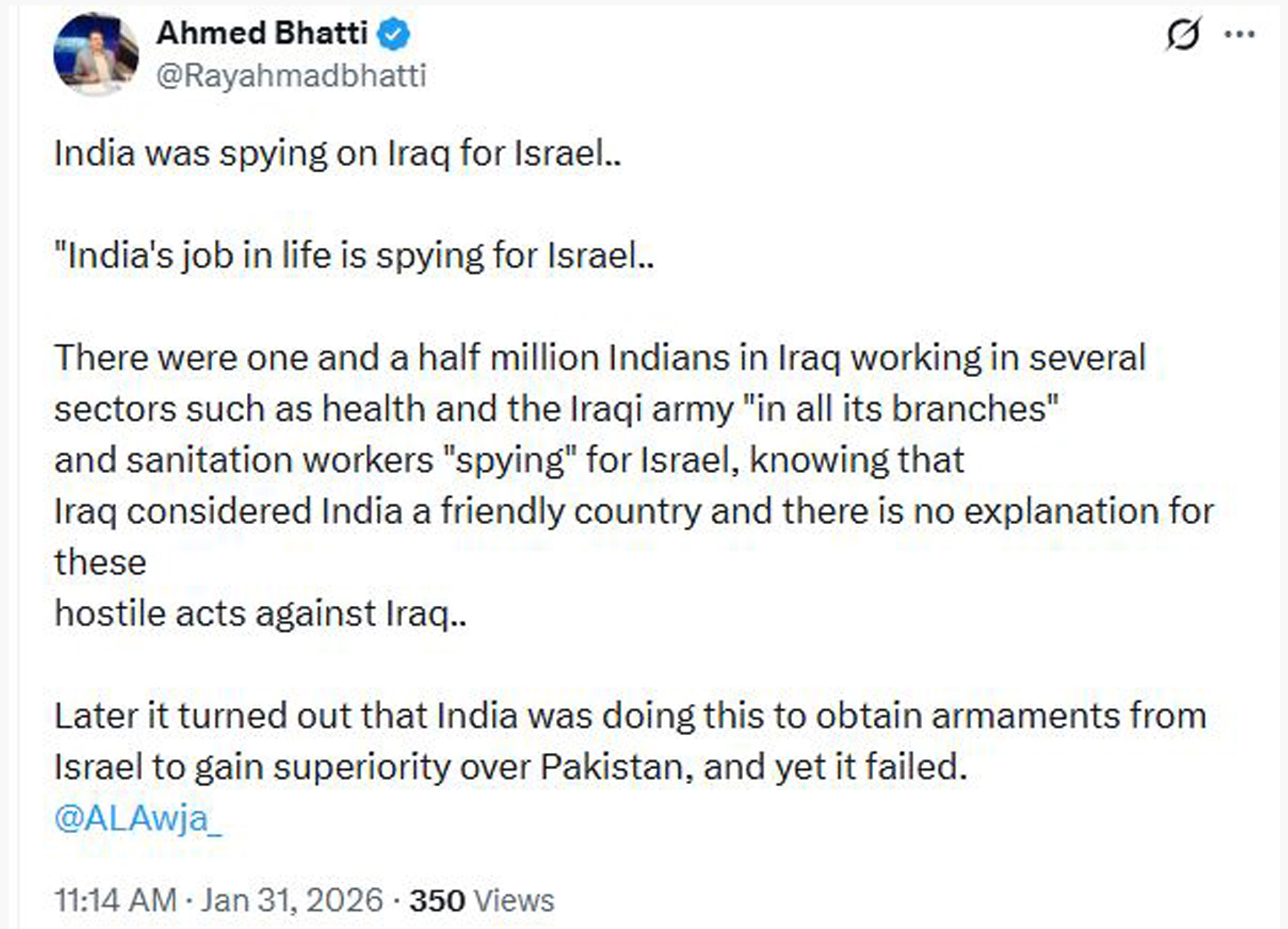
Bhatti wrote:
“India was spying for Israel in Iraq. India’s main job, in practice, is spying for Israel. Around 1.5 million Indian nationals were employed in Iraq across various sectors, including healthcare, all branches of the Iraqi military, and even municipal services and sanitation, while simultaneously spying for Israel. This was happening despite Iraq considering India a friendly country, with no justification for such hostile activities against Baghdad. It later emerged that India was carrying out these activities to obtain weapons from Israel and gain military superiority over Pakistan; however, it ultimately failed to achieve that objective as well.”
These statements reflect allegations circulated by the journalist and cited analyst; the claims concerning the alleged activities of Indian nationals have not been independently established in the material presented.
Al-Arabi Al-Istiqlal Report: Israeli Aggression and the Exposure of an Espionage Network
In an extensive report, the Arab news outlet Al-Arabi Al-Istiqlal described Israel’s June 13, 2025, attack on Iran not merely as a military assault, but as the moment that exposed one of the most sophisticated espionage networks of the past quarter-century.
According to the publication, the network had been developed by Mossad over many years in a “quiet, patient and covert” manner, operating as a modern-day fifth column inside Iran and across the region. The report claimed that this network enabled Israel to penetrate deeply into technical, military and even nuclear infrastructure.
The Indian Diaspora as a “Trojan Horse”
According to the report, Mossad, working closely with India’s intelligence apparatus, used Indian communities living in Iran and Gulf countries as instruments of intelligence penetration.
The individuals concerned were reportedly active in technical services, construction, technology, banking, telecommunications, airports and seaports. The report alleged that their professional positions provided direct access to sensitive infrastructure, allowing information to be transferred to intelligence networks.
Serious Allegations of Arrests and Diplomatic Expulsions
Tejaswi Prakash, described as a prominent human rights activist and former member of India’s Congress party, claimed that 73 Indian nationals had been arrested in Iran on charges of spying for Israel. He also accused India’s ruling government of implicit complicity.
According to Prakash, the Indian Human Rights Watch also confirmed that, after Iran arrested at least 19 Indian nationals, several Indian diplomats were expelled from the country. The reported action further intensified tensions between Tehran and New Delhi.
These allegations, including the reported number of detainees and claims of diplomatic expulsions, require independent verification.
Executions and a Wave of Arrests in Iran
According to reports by Iran’s Mizan News Agency and coverage attributed to international media outlets, including CNN and Reuters, Iranian authorities arrested dozens of people accused of cooperating with Mossad and executed several individuals in connection with such allegations.
According to CNN’s report dated June 17, 2025:
Twenty-eight people were arrested in Tehran, while approximately 60 others were detained in Isfahan on allegations of cooperation with Mossad.
On June 23, 2025, Iran also announced the execution of several defendants, including foreign nationals.
A 25-Year Intelligence Partnership Between RAW and Mossad
Reports suggest that intelligence cooperation between India and Israel accelerated following the Kargil War in 1999 and developed into a shared strategic doctrine after the 2008 Mumbai attacks.
According to analytical sources cited in the reports, Mossad designed operational scenarios, while India’s intelligence agency, the Research and Analysis Wing (RAW), supplied the necessary personnel from among Indian diaspora communities across the region.
The alleged arrangement was described as a long-term intelligence partnership combining operational planning with access to local communities and strategically important sectors.
Technology Companies and Commercial Cover
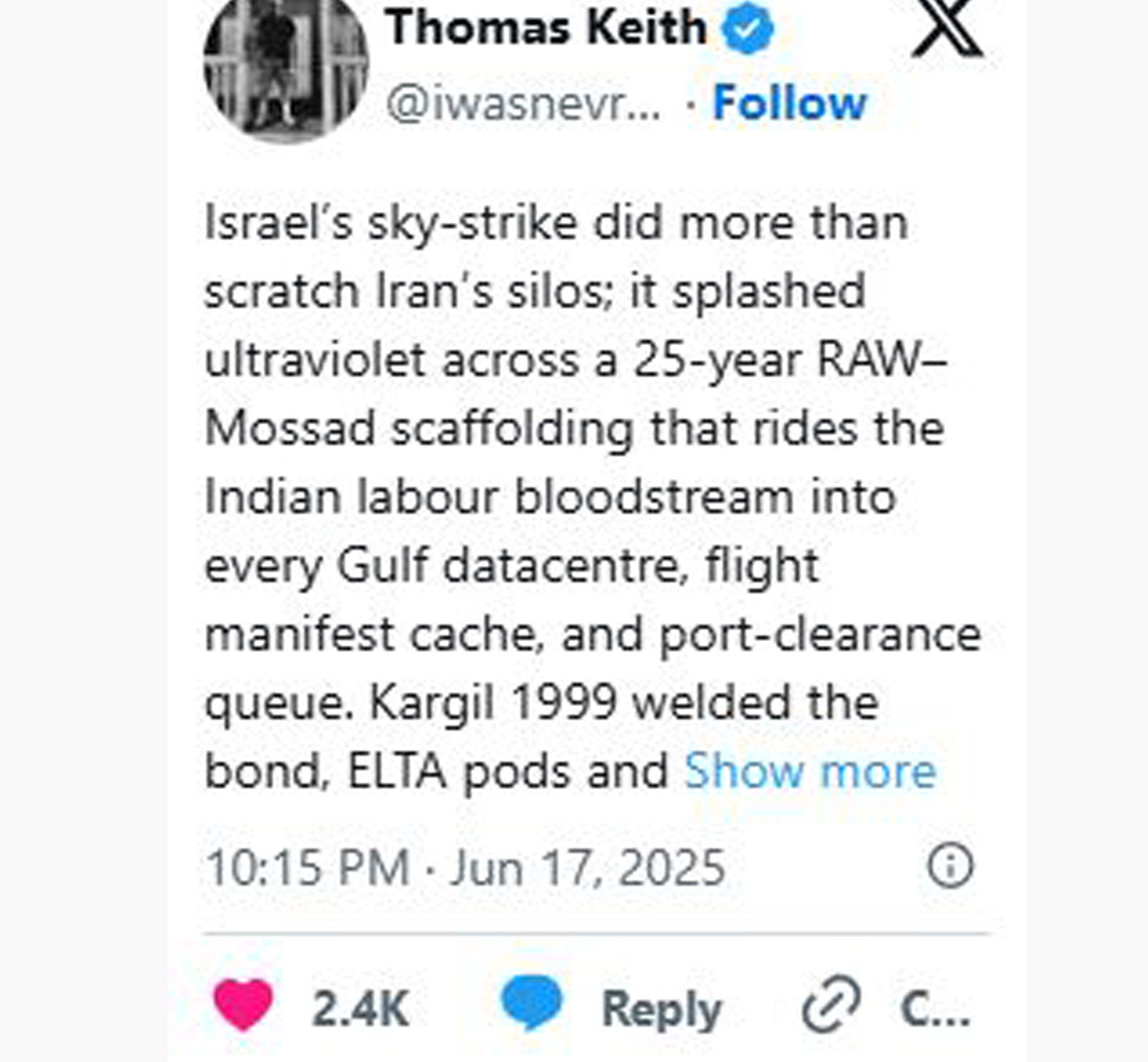
A lengthy post by Thomas Keith, described as a prominent account on X, alleged that Indian intelligence was the principal architect behind deep intelligence penetration inside Iran.
Keith claimed that the Indian-Israeli espionage network had spread among millions of Indian migrants living in Iran, the United Arab Emirates, Saudi Arabia and Qatar. Many of these individuals, he alleged, worked in critical sectors such as telecommunications, banking, airports and seaports.
He further claimed that major companies, including TCS, Wipro and L&T, played key behind-the-scenes roles in sustaining the alleged covert apparatus, maintaining the network under the cover of technical services.
These assertions concern named companies and serious allegations of intelligence activity; they should be understood as claims made in the cited social media post rather than independently verified findings.
Security Implications and Regional Consequences
Analysts cited in the reports contend that such a network could potentially enable the monitoring of, or interference with, critical infrastructure without firing a single shot.
The infrastructure identified includes:
Telecommunications networks
Airports
Seaports
Banking systems
According to these assessments, the alleged capabilities became apparent during Israel’s military assault on Iran, when intelligence penetration was said to have played a significant role in the broader confrontation.
Responses and Attempts at Denial
While Indian media outlets and organisations such as DFRAC reportedly sought to deny claims concerning the arrest of Indian nationals, multiple Iranian, Arab and Western media reports have been cited as indicating the scale of the alleged intelligence penetration.
According to The Times of Israel, Iran arrested more than 700 people on suspicion of links to Israel during the 12-day war.
The reports have fuelled debate over the alleged scope of intelligence cooperation between Israel and India, the potential use of diaspora communities for intelligence purposes, and the security implications for countries across the Middle East.
A Hidden Intelligence War Behind the Military Confrontation
The allegations surrounding Israel’s military assault on Iran point to a wider narrative of covert intelligence operations extending beyond the battlefield.
According to the cited reports and commentary, the alleged network involving Mossad, RAW and members of the Indian diaspora had developed a presence across strategically important parts of the region, with access to sensitive sectors and infrastructure.
The extent of these claims, including the alleged involvement of Indian nationals and commercial entities, remains a matter requiring careful independent verification. Nevertheless, the allegations have placed renewed attention on the intersection of intelligence cooperation, regional rivalries and the security of critical infrastructure across the Middle East.