
The Architecture of Allegiance: How American Networks May Shape Pakistan’s Ruling Elite and Foreign Policy
The Pakistani research and media outlet Brief has examined the role of American educational networks, military cooperation, financial ties, and professional connections in shaping the relationship between Pakistan’s ruling elite and Western centers of power.
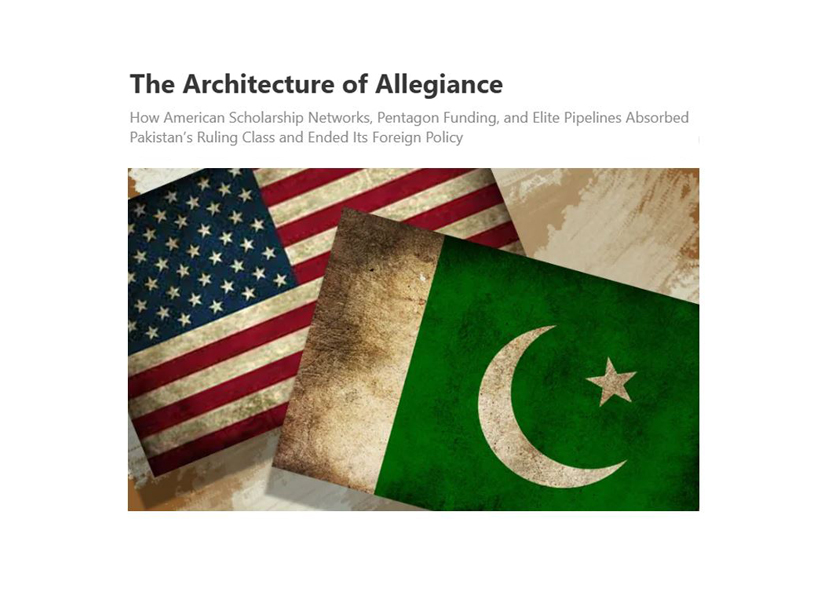
ISLAMABAD : According to Raaz News | The Pakistani research and media outlet Brief has examined the role of American educational networks, military cooperation, financial ties, and professional connections in shaping the relationship between Pakistan’s ruling elite and Western centers of power. In an article titled “The Architecture of Allegiance,” the publication presents an analysis suggesting that Islamabad’s foreign policy may be influenced not only by national interests but also by the interests, affiliations, and networks of the country’s powerful elite.
The article’s central argument is that understanding Pakistan’s foreign policy requires looking beyond official diplomatic positions and examining the social, educational, financial, and institutional relationships that connect influential Pakistanis with Western political and economic circles. According to the analysis, these relationships may contribute to the formation of shared interests and policy preferences, potentially affecting how Pakistan defines its national priorities and engages with major international powers.
Educational Networks: Beyond University Degrees
The article highlights the educational backgrounds of members of influential Pakistani families, particularly their connections to prominent Western academic institutions. Georgetown University, the London School of Economics, Columbia University, Sciences Po in Paris, and Harvard University’s Kennedy School of Government are cited as examples of institutions associated with the educational and professional environments of Pakistan’s elite.
According to the author, the significance of these connections extends beyond academic qualifications. Alumni networks, professional opportunities, career advancement, and sustained interaction with international political and economic circles may also influence individuals’ perspectives, professional relationships, and policy priorities.
Within this framework, the article raises a broader question: To what extent can the educational and professional ties of Pakistan’s elite with Western institutions, alongside other domestic and international factors, shape their understanding of Pakistan’s national interests and influence the country’s relations with global powers?
American Military Cooperation and Financial Leverage
Another major theme is the security and military relationship between Washington and Islamabad. The author identifies Pentagon funding, defense cooperation, and institutional ties between the two countries’ military establishments as factors that may influence Pakistan’s security priorities and strategic calculations.
The analysis also considers the connections among Pakistan’s political, economic, military, and administrative elites, suggesting that their relationships with foreign power networks may interact with domestic institutional structures to influence decision-making in Islamabad.
The broader argument is that the effects of foreign influence may not always be visible in explicit diplomatic instructions or publicly announced agreements. They may also operate through established institutional relationships, shared professional experiences, and the incentives associated with continued cooperation.
The Pipeline System: Think Tanks, Policy Recommendations, and IMF Conditionality
Under a section titled “The Pipeline System,” the article examines the role of think tanks and policy institutions in shaping Pakistan’s economic and political decisions. The author argues that connections between these institutions and international financial structures, including the International Monetary Fund (IMF), may help transmit and reinforce policy approaches favored by Western institutions.
According to this argument, individuals working in think tanks and related policy organizations contribute to the development of policy papers, economic recommendations, and proposals that can inform subsequent government decisions. The author suggests that some of these recommendations may later be reflected in international lending conditions or economic reform programs, potentially deepening Pakistan’s integration into the global financial system.
The author further argues that this structure should be examined as an interconnected system rather than as a collection of separate, publicly visible relationships.
In this context, the article identifies Afghanistan, relations with China, the China–Pakistan Economic Corridor (CPEC), Kashmir, and Iran as issues on which Islamabad’s strategic choices may intersect with Washington’s priorities.
According to the author’s interpretation, alignment between Pakistan’s policies and American preferences does not necessarily require explicit instructions transmitted through diplomatic channels. It may instead emerge when decision-makers have been educated, professionally socialized, or institutionally connected within environments that encourage particular ways of understanding international affairs.
The Ruling Elite: A Network Extending Across State Institutions
The article places particular emphasis on the composition and institutional reach of Pakistan’s ruling elite. Rather than focusing exclusively on individual politicians or senior officials, its framework considers influential networks operating across different parts of the political, economic, and administrative system.
The author points to areas including the Ministry of Finance, the Ministry of Foreign Affairs, media editorial circles, and the central bank as parts of the broader institutional environment in which members of the elite and their professional networks operate.
The Intergenerational Reproduction of Influence: Voluntary Alignment or Structural Constraint?
Another central argument concerns how foreign influence may be reproduced over successive generations without relying on direct coercion.
According to the author, individuals who participate in these educational, professional, and institutional networks may view their international connections as opportunities for personal advancement, access to prestigious positions, and professional success. They may not necessarily perceive their participation as part of a broader structure that could influence their country’s political independence.
The article distinguishes between direct coercion and what it presents as structural influence. Under this interpretation, alignment with Western priorities may develop through shared values, professional relationships, institutional incentives, and common assumptions about international affairs rather than through explicit orders.
The author’s argument is that a system of influence can persist even when the individuals operating within it believe they are pursuing legitimate professional and personal goals. Educational and career pathways may reproduce established relationships and perspectives across generations, potentially reinforcing existing patterns of elite interaction.
This raises a fundamental question: Are educational, economic, and professional ties with Western countries simply instruments of individual advancement and international cooperation, or can they also affect a country’s ability to formulate an independent foreign policy?
Asymmetric Dependence and the Limits of Foreign Policy Autonomy
The concept of asymmetric dependence provides an additional framework for the article’s argument. It describes a relationship in which two parties possess unequal levels of power, resources, or freedom of action.
Applied to Pakistan’s relationship with the United States, the concept raises the possibility that sustained educational, financial, and security ties could increase the costs of diverging from Washington’s preferences. If important institutions or influential groups depend on relationships that are difficult to replace, the range of politically or economically viable choices available to policymakers may become narrower.
Under this interpretation, foreign influence need not involve direct intervention in every decision. Existing relationships and dependencies may instead shape the incentives, constraints, and assumptions that influence the choices available to a government.
The article therefore encourages readers to examine not only formal agreements and official diplomatic exchanges but also the underlying structures of dependence that may affect Pakistan’s strategic calculations.
The Central Question: National Interests or Elite Interests?
Ultimately, “The Architecture of Allegiance” turns its attention to the relationship between Pakistan’s domestic power structure and its foreign policy.
Its central question is whether Islamabad’s strategic decisions are primarily shaped by the interests and priorities of Pakistan’s citizens or whether the interests, affiliations, and international connections of influential groups also play a substantial role in determining the country’s direction.
By bringing together educational networks, military cooperation, financial relationships, think tanks, and institutional connections, the article presents a framework for examining how influence may operate beyond formal diplomatic channels.
Its broader argument is that Pakistan’s foreign policy cannot be fully understood by examining official statements and government decisions in isolation. The relationships among influential individuals, domestic institutions, international financial structures, and Western centers of power may also warrant scrutiny.
The issue ultimately raised by the article is whether Pakistan’s international relationships strengthen its capacity to pursue its national interests or create structural incentives that may, in certain circumstances, constrain its strategic independence.