
Pakistani officer in Saudi operations room caught off guard by presence of Israeli intelligence officers
Israeli media outlets have reported that a Pakistani army officer—deployed to Saudi Arabia as part of a defense assistance mission—encountered Israeli intelligence officers alongside personnel from the U.S. Central Command (CENTCOM) during an intelligence briefing in Riyadh. This account could shed light on new dimensions of security cooperation between Saudi Arabia and Israel—facilitated by Washington—as well as the sensitivities this presents for Islamabad.
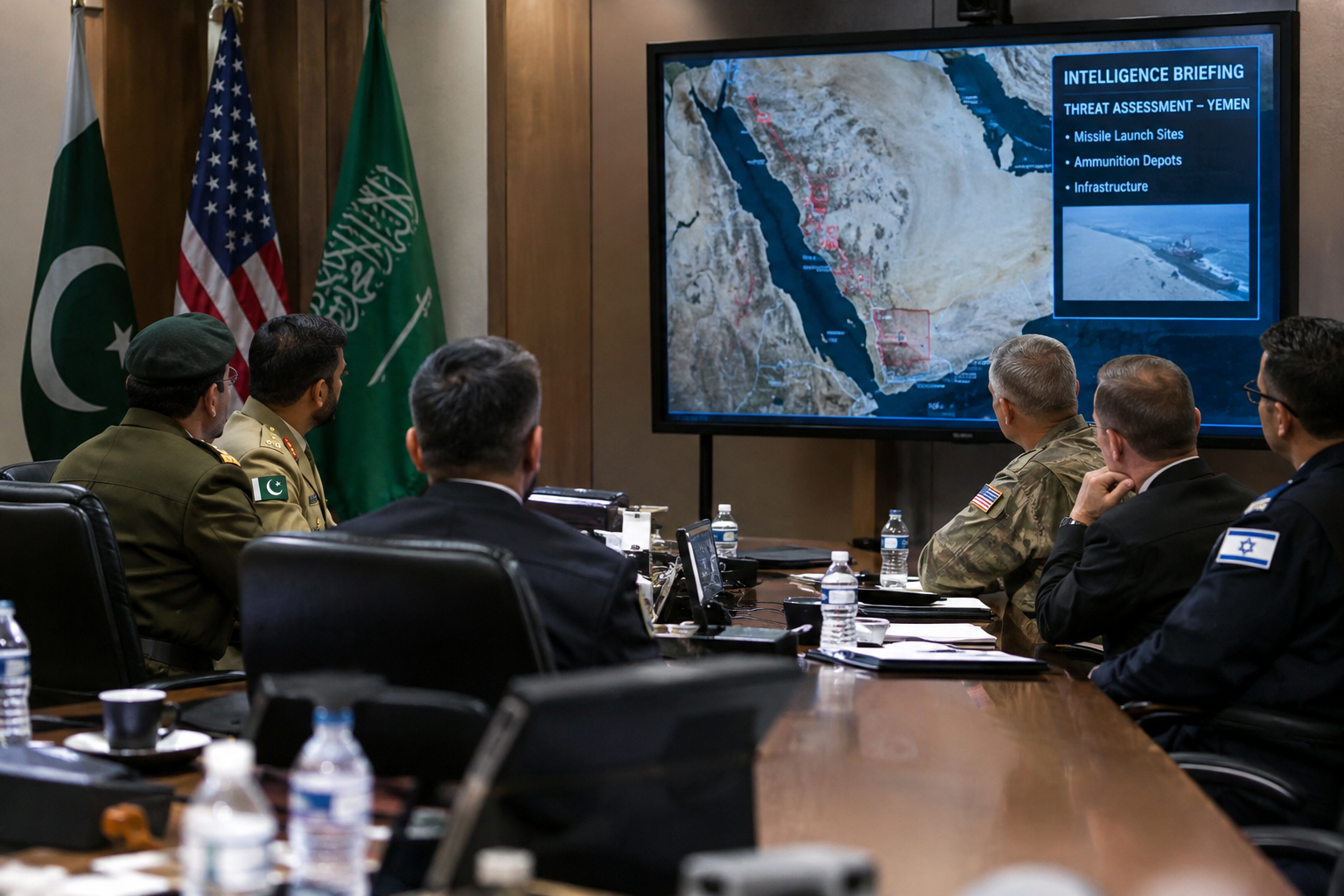
Saudi Arabia has pursued two parallel channels to strengthen its defenses against escalating Houthi missile and drone attacks: an official military cooperation framework involving Pakistan and Turkey, and a covert intelligence channel coordinated through the United States Central Command (CENTCOM), according to reports by Israeli media outlets Nziv and JFeed. The reports describe an intelligence briefing in Riyadh attended by Saudi, Pakistani, American, and Israeli personnel, highlighting the complex security arrangements and political sensitivities surrounding regional cooperation.
Pakistani Officer Discovers Israeli Intelligence Personnel in Riyadh
Israeli news outlet JFeed, in a report titled “Pakistani Finds Israelis in Saudi Ops Room,” describes the experience of a Pakistani army officer deployed to Saudi Arabia to assist in countering the Houthis in Yemen. The officer was reportedly surprised to discover Israeli intelligence personnel sitting alongside American CENTCOM representatives during an intelligence briefing in Riyadh.

The account has circulated widely across Arab social media platforms and international podcasts. The report places the incident within broader geopolitical developments in the Middle East, particularly the growing security coordination surrounding the conflict in Yemen and the involvement of regional and international powers.
Israeli intelligence platform Nziv has also linked reports of the Riyadh briefing to Saudi-Israeli intelligence cooperation aimed at countering Houthi attacks, drawing attention to the political and geopolitical implications for the countries involved.

Two Parallel Channels of Saudi Security Cooperation
According to JFeed, Saudi Arabia faced a sharp escalation in Houthi missile and drone attacks during the second half of 2026, prompting Riyadh to pursue two parallel approaches to strengthening its defenses.
The first channel is an official military cooperation framework involving Pakistan and Turkey, referred to in the report as the “Mecca Alliance.” Under this arrangement, Pakistani military advisers and personnel were deployed to Saudi Arabia to assist in defending the kingdom, primarily in a defensive capacity. Pakistan has officially confirmed the presence of its forces under the new agreement.
The second channel involves intelligence assistance coordinated through the United States Central Command. Israeli and international media reports published in September 2026 indicated that Saudi Arabia had requested and received Israeli intelligence support to counter the Houthis.
The intelligence assistance reportedly focused on identifying missile launch sites, weapons and ammunition depots, and missile infrastructure along the Red Sea coast. The cooperation was coordinated through American mediation, without the establishment of formal diplomatic relations between Saudi Arabia and Israel.
The reports also point to gaps and limitations in Saudi Arabia’s defense cooperation with Pakistan as one factor behind Riyadh’s search for additional intelligence capabilities.
Trump Says Israel Has Helped Saudi Arabia Significantly
US President Donald Trump has also spoken about Israeli assistance to Saudi Arabia in its campaign against the Houthis in Yemen.
According to JFeed, Trump was asked whether the Abraham Accords had returned to the agenda and whether Saudi-Israeli normalization was being reconsidered. He responded: “Yes, I think so. Maybe more than ever before. Saudi Arabia is very happy to receive Israel’s support and our support.”
When asked whether Riyadh should accept the Israeli assistance being offered to it, Trump replied: “Yes, I think so. Israel has helped Saudi Arabia a lot.”

CENTCOM as a Bridge Between Israel and Arab States
The reports identify CENTCOM as a central mechanism facilitating military and intelligence coordination between Israel and Arab countries that do not maintain formal diplomatic relations with the Israeli government.
Since Israel was transferred to CENTCOM’s area of responsibility, the US military command has provided a framework for practical security cooperation between Israel and regional partners. This arrangement enables military coordination and intelligence exchanges without necessarily requiring publicly acknowledged bilateral relations.
Within this framework, the reported presence of Israeli intelligence personnel at a briefing in Riyadh alongside American and Pakistani officers has raised questions about the extent of intelligence coordination taking place behind the scenes.
The reports also highlight the potential political implications for Pakistan, a Muslim-majority country that does not recognize Israel. The presence of Pakistani officers at meetings involving Israeli intelligence personnel, or the use of intelligence originating from Israel, could create political sensitivities in Islamabad and raise questions about the limits of cooperation under the Mecca Alliance.
Security Cooperation Despite the Freeze in Normalization
Nziv’s analysis places the reported intelligence cooperation within the broader context of Saudi-Israeli relations and the stalled normalization process.
Although Riyadh has publicly frozen progress toward normalization with Israel, the reports suggest that this position does not necessarily preclude continued security and technical coordination behind the scenes.
According to the analysis, practical security requirements may continue to drive cooperation even when political considerations prevent the establishment of formal diplomatic relations. CENTCOM’s coordinating role provides a framework through which such cooperation can take place without an official public announcement of bilateral ties.
Abdul-Malik al-Houthi’s Statement on Israeli Intelligence Flights
The Nziv report also references statements by Abdul-Malik al-Houthi, the leader of Yemen’s Houthi movement, concerning Saudi Arabia’s role in facilitating Israeli intelligence operations.
According to the account, al-Houthi said Saudi Arabia had opened its airspace to Israeli intelligence flights as part of an intelligence-sharing arrangement.