30th Session of ECO Council of Ministers Begins in Islamabad; Pakistan and 9 Regional Countries on Path to Strengthen Economic Ties
The two-day 30th session of the Council of Ministers of the Economic Cooperation Organization (ECO) began on Sunday with a preparatory meeting of senior officials of member states in Pakistan's capital.
Islamabad: According to Raaz News | The two-day 30th session of the Council of Ministers of the Economic Cooperation Organization (ECO) began on Sunday with a preparatory meeting of senior officials of member states in Pakistan's capital — a meeting attended by foreign ministers and heads of delegations of 10 member countries, focused on strengthening regional cooperation, developing trade, and expanding economic connectivity.
The session is chaired by Mohammad Ishaq Dar, Deputy Prime Minister and Foreign Minister of Pakistan, and the main meeting of the Council of Ministers is scheduled to be held on Monday. Representatives of the ECO Secretariat and affiliated institutions are also present at the summit.
Pakistan, which holds the rotating ECO chairmanship for 2026 and 2027, has placed the slogan "Reviving Regionalism for a Resilient ECO" at the center of its agenda. Pakistan's Foreign Ministry has announced that during the country's chairmanship, strengthening regional connectivity, deepening economic integration, developing regional partnerships, and advancing joint efforts to achieve prosperity and sustainable development will be on the agenda.
Focus on Trade, Transit, and Regional Connectivity
According to a statement from Pakistan's Foreign Ministry, this meeting provides an opportunity to strengthen ECO's position as an effective platform for regional cooperation, dialogue, and economic engagement.
Islamabad, during its chairmanship, also seeks to strengthen Pakistan's role as a regional connectivity hub, facilitator of logistics routes and supply chains, and a pioneer in setting the regional trade agenda.
In this framework, developing transport and transit routes, expanding trade exchanges, and utilizing the economic capacities of member states can pave the way for increased joint cooperation and improving the living standards of the region's people.
Iranian Delegation's Presence at the Islamabad Meeting
A delegation of the Islamic Republic of Iran is also present at this meeting. The Iranian delegation is headed by Alireza Totonchian, Director-General for Multilateral Economic Cooperation at the Ministry of Foreign Affairs.
Simultaneously with the start of the meeting, delegations from member states and officials from regional and international organizations have arrived in Islamabad to participate in the summit.
Ahmad Saidmuradzadeh, Deputy Secretary-General of the Shanghai Cooperation Organization, Ismail Ould Cheikh Ahmed, Secretary-General of the Organization of Islamic Cooperation, Musa Kulaklikaya, Deputy Foreign Minister of Turkey, Elnur Mammadov, Deputy Foreign Minister of the Republic of Azerbaijan, and Arman Isakaliev, Deputy Foreign Minister of Kazakhstan, are among the officials who have arrived in Pakistan's capital along with their delegations. These officials were welcomed at Islamabad International Airport by officials of Pakistan's Foreign Ministry.
ECO; A Framework for Economic Cooperation of 10 Regional Countries
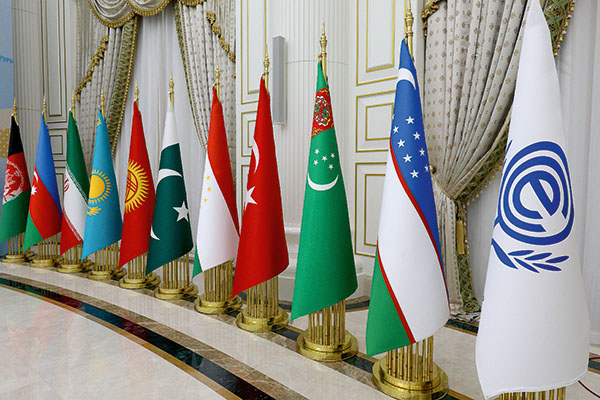
The Economic Cooperation Organization (ECO) was established in 1985 on the initiative of Iran, Turkey, and Pakistan, and its scope of activity expanded in 1992 with the accession of seven other countries.
Afghanistan, the Republic of Azerbaijan, the Islamic Republic of Iran, Kazakhstan, Kyrgyzstan, Pakistan, Tajikistan, Turkmenistan, Turkey, and Uzbekistan are the 10 members of this organization.
Strengthening economic and trade cooperation, sustainable development, expanding cooperation in agriculture, energy, transport, and communications, improving people's living standards, and reducing poverty are among the most important goals of ECO. The organization also pursues these goals through specialized meetings, exchange of experience, drafting joint plans, and efforts to attract investment.
Estimates show that the total nominal GDP of ECO member states reaches about three trillion dollars; an economic capacity that, if communication infrastructure is strengthened, trade is facilitated, and coordination among members is increased, can play an important role in expanding regional economic ties.
The 30th ECO Council of Ministers meeting is being held as regional countries, with extensive capacities in energy, transit, trade, and human resources, have significant opportunities for developing multilateral cooperation. Utilizing these capacities and transforming political and economic agreements into practical projects will be one of the most important tests facing this organization in the new period of Pakistan's chairmanship.