
18 Islamic and Arab Countries Condemn Israel's Attack on Nasser Hospital in Gaza
Following Israel's airstrike on the Nasser Medical Complex in southern Gaza, which led to the martyrdom of at least 6 Palestinians, including a surgeon, and the wounding of 20 others, the foreign ministers of 18 Islamic and Arab countries condemned the attack.
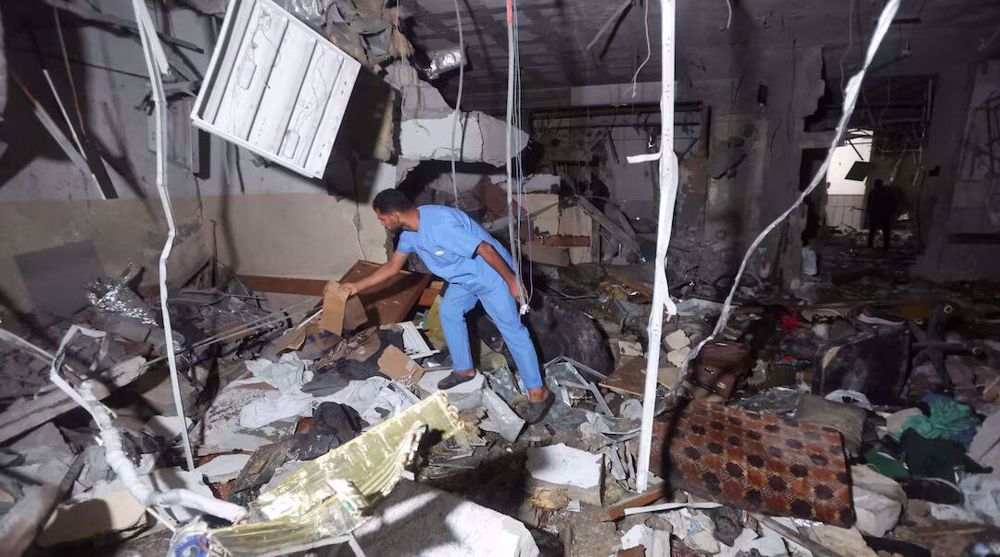
Gaza: According to Raaz News | Following Israel's airstrike on the Nasser Medical Complex in southern Gaza, which led to the martyrdom of at least 6 Palestinians, including a surgeon, and the wounding of 20 others, the foreign ministers of 18 Islamic and Arab countries condemned the attack and called for an end to the aggressions, protection of medical centers, and the lifting of restrictions on the entry of humanitarian aid into Gaza.
These ministers, in a joint statement published on Saturday, described the attack on the Nasser Medical Complex as a blatant violation of international humanitarian law and emphasized that hospitals, medical centers, patients, and medical staff enjoy special protection under international law — a protection that Israel's attack has severely violated.
According to the Gaza Ministry of Health and Civil Defense, Israel's airstrike in the early hours of November 12 on the Nasser Medical Complex left at least 6 martyrs and 20 wounded. Among the martyrs of this attack was a surgeon.
Continued Attacks on Civilians and Threats to the Ceasefire
The foreign ministers signing the statement also condemned Israel's continued attacks on Palestinian civilians, including the bombardment of temporary shelter sites for displaced persons, and warned that the continuation of these attacks seriously threatens the ceasefire and international efforts to establish security and stability in Gaza.
These positions are being expressed as Israel, despite the ceasefire agreement, has repeatedly resumed its attacks on residential areas and Palestinian civilians under various pretexts, and by continuing its aggressions, has kept the lives of Gaza's residents in danger.
Restrictions on Aid Entry; A Deadly Threat to Displaced Persons on the Eve of Winter
One of the main axes of the statement was Israel's continued restrictions on the entry of humanitarian aid into the Gaza Strip. The foreign ministers expressed particular concern over the prevention of entry of essential items for sheltering the displaced, including tents, caravans, and prefabricated homes, as well as medical equipment and supplies.
They warned that as the cold season approaches, the deterioration of living conditions, the lack of shelter, and the collapse of water, health, sanitation, and medical services increasingly threaten the lives of civilians, especially children and infants.
The statement emphasized that depriving children of shelter and adequate humanitarian support exposes them to the risk of death from cold — a danger that, alongside the consequences of war and displacement, exacerbates the dimensions of the humanitarian catastrophe in Gaza.
Demand for Implementation of Ceasefire Commitments and Opening of Aid Routes
The foreign ministers called on Israel to respond to the demands of the international community and the peace board and to fully and immediately implement its commitments under the Sharm El-Sheikh agreement and UN Security Council Resolution 2803, adopted in 2025.
They also called for Israel's adherence to the ceasefire, protection of civilians and medical centers, and ensuring the safe, continuous, and unrestricted entry of adequate humanitarian aid into Gaza.
According to the statement, the needed aid should include emergency shelter, items necessary for initial reconstruction, and essential equipment for the revival of vital infrastructure. The foreign ministers also emphasized that UN agencies and relief organizations must be able to operate in Gaza without obstacles or restrictions.
They stated that commitments related to the first phase of the agreements should have been implemented immediately after signing and should not be delayed by additional political or security conditions; also, immediate aid to the people of Gaza should not be conditional on the progress of negotiations or the implementation of later stages of the plan.
Call on Washington to Press Israel
In another part of the statement, the US and the peace board were asked to increase their efforts to compel Israel to fully implement its commitments and to pave the way for the lifting of all restrictions imposed on the entry of humanitarian aid into Gaza.
The foreign ministers warned that the implementation of these commitments is essential to preserving the credibility of the agreements and strengthening the ceasefire — an issue that, given the continuation of Israeli attacks and the prevention of the entry of basic needs for the people of Gaza, continues to face serious challenges.
The joint statement was signed by Algeria, Djibouti, Turkey, Egypt, Indonesia, Jordan, Kuwait, Lebanon, Libya, Mauritania, Oman, Pakistan, Palestine, Qatar, Saudi Arabia, Somalia, Sudan, and the United Arab Emirates.
However, diplomatic condemnations alone cannot prevent the continuation of Israel's crimes; what the people of Gaza urgently need is an end to the attacks, an end to the imposed restrictions, the uninterrupted entry of humanitarian aid, and the practical implementation of ceasefire commitments. As long as Israel continues to violate these commitments and deprive the Palestinian people of the most basic necessities of life, the humanitarian crisis in Gaza will also persist.