
Pakistan’s Role in the Iran-US Crisis: A Secret Briefing, a Failed “Plan A,” and the Search for “Plan B”
An exclusive report by Raz News says that US President Donald Trump briefed Pakistan’s army chief, Field Marshal Asim Munir, on the operation against Iran that led to the martyrdom of Ayatollah Seyyed Ali Khamenei...
Islamabad: According to Raz News, a senior source who accompanied the Pakistani delegation on its visit to the United States and wished to remain anonymous has revealed precise details of Pakistan’s role in the Iran–US crisis in an exclusive interview with the “Raz News” news agency.
According to this report, US President Donald Trump personally met with Field Marshal Syed Asim Munir, Pakistan’s army chief, before the military attack on Iranian territory and the operation that led to the martyrdom of Ayatollah Seyyed Ali Khamenei, the Leader of the Islamic Revolution, and briefed him on the details of this assassination operation.
The aforementioned source, who closely observed the Pakistani delegation’s interactions in Washington, described the meeting not as a diplomatic process, but as a full briefing on the assassination operation.
In the continuation of his interview with Raz News, the senior source stated: “The purpose of this move was to inform Pakistan about the operation so that, under ‘Plan A,’ it could play its role as a seemingly neutral country alongside the United States in managing the consequences of Iran’s collapse.”
The source emphasized that the atmosphere surrounding this special meeting reflected not an equal partnership, but the receipt of instructions from the United States. The scenario was simple: regime change in Tehran would open the door for Pakistan to help the United States manage the aftermath. The plan was presented as a “win-win” situation, although it was always clear who would benefit the most.
The Failure of “Plan A” and the Activation of “Plan B”
As history has repeatedly shown, “Plan A” failed. Iran resisted and stood its ground; what was supposed to be a swift victory and a geopolitical realignment turned into a complex deadlock. According to the source, “Plan B” was quickly designed and implemented.
Following the initial failure, the United States once again turned to its longtime ally in South Asia and asked Pakistan to find a way out of the crisis. At this stage, Mohsin Naqvi entered the scene and assured General Asim Munir that he had an “extensive network of influence” in Iran; connections through which key figures could be persuaded or pressured into accepting an agreement that, in essence, meant imposing a strategic defeat on Iran.
In this account, there was no need for an operation on the ground; Pakistan was ready to play a role on the diplomatic front.
A Repeated and Enduring Pattern
This pattern has been repeated with almost mechanical precision: Washington makes the decision, Pakistan’s military command obeys, provides the necessary intelligence or logistical cover, or maintains the required “neutrality,” and then, when the plans fall apart, attempts to preserve at least the appearance of its position. This relationship looks less like an alliance and more like a constant test of approval from the United States.
The source emphasized that, during this visit, the Pakistani delegation acted less as an independent player and more as an endorser of US policies. The United States set the objectives, while Islamabad occupied itself with adjusting the details to suit Washington’s preferences. In this account, “Plan A” involved exploiting the potential power vacuum following the removal (martyrdom) of Iran’s leader by sending Jaish al-Adl terrorist forces from southern Iran, while “Plan B” involved designing an exit strategy—a dignified way out of a crisis that “Plan A” had failed to resolve.
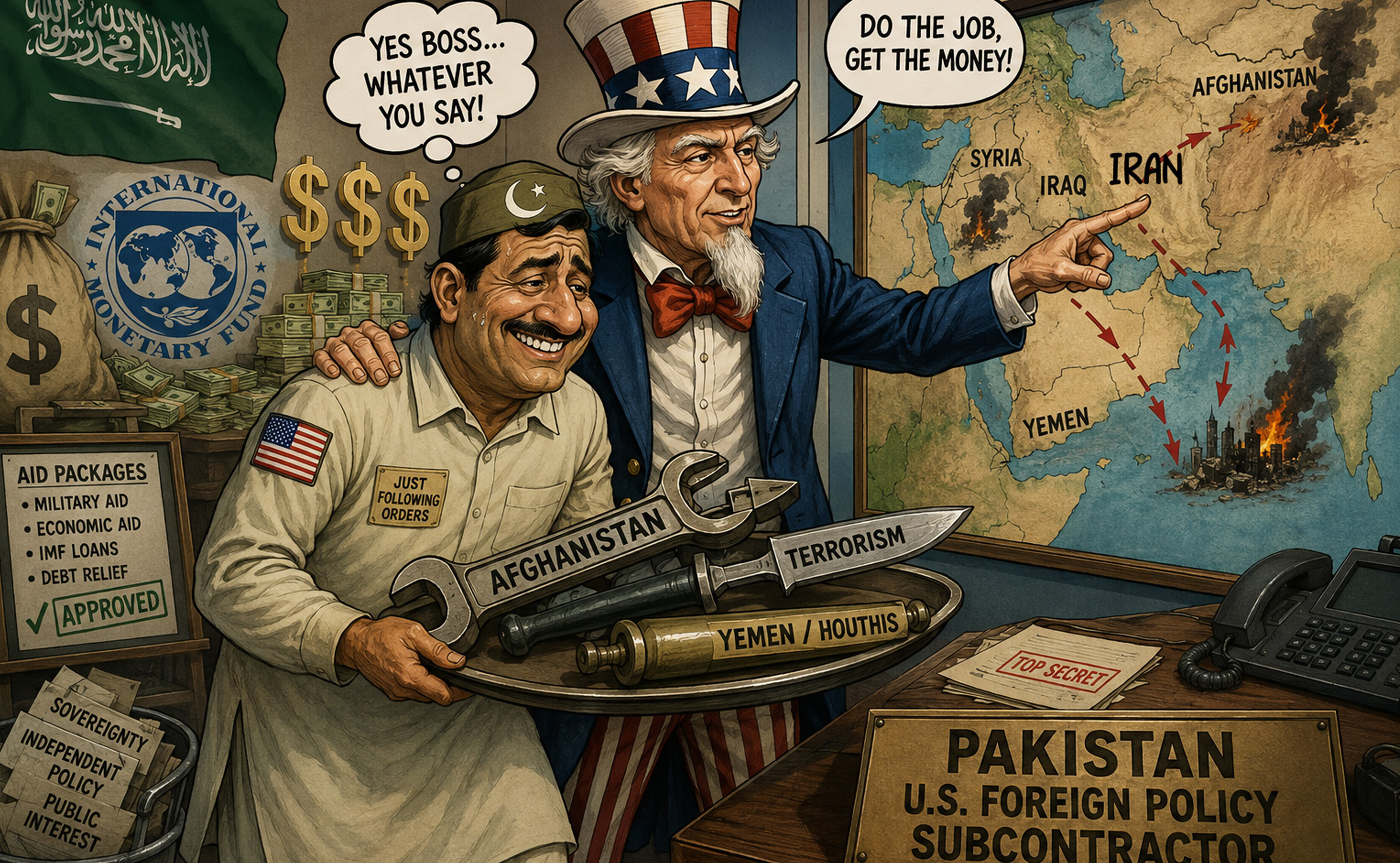
It should be noted that the revelations in this report are based on Pakistan’s record as America’s lackey in the region—a country that has fought for the United States in Afghanistan at various times, served as a platform for US-backed terrorism, and joined the war against the Houthis in Yemen in coordination with Saudi Arabia—all in service of US interests.
These are not merely allegations found in opposition media; rather, they have been acknowledged repeatedly, both explicitly and implicitly, in statements by Pakistani officials themselves, as well as in reports by major international news agencies.
Pakistan’s role as America’s subservient instrument for US foreign policy—from its logistical support during the “War on Terror” to its silent complicity in regional proxy wars, often justified under the banners of “strategic depth” or “Islamic solidarity”—is well documented, although the common thread in every instance remains the same: Washington’s agenda, Islamabad’s execution.
Whether fighting in America’s wars, hosting its proxies, or joining coalitions against actors aligned with Iran, Pakistan has consistently presented itself as the most reliable regional contractor for the geopolitical projects of the United States. Some might call it loyalty—perhaps not.
The reality, regardless of diplomatic niceties, is this: Pakistan has been, and will continue to be, an eager servant of US interests in the region. For decades, Islamabad has traded sovereignty for subsidies, dignity for dollars, and strategic independence for International Monetary Fund assistance. This pattern is no accident—it is institutionalized; and Pakistan’s role as the United States’ most reliable foreign-policy contractor in the region is unlikely to change.