
Pakistan’s Emergency Rule in Khyber Pakhtunkhwa Sparks Political Storm: Civilian Decision or Military Influence?
Pakistan’s federal government has come under mounting criticism following its decision to impose emergency rule and federal governor’s rule in Khyber Pakhtunkhwa, triggering a heated debate over constitutional authority, provincial autonomy and the military’s influence over the country’s political affairs.
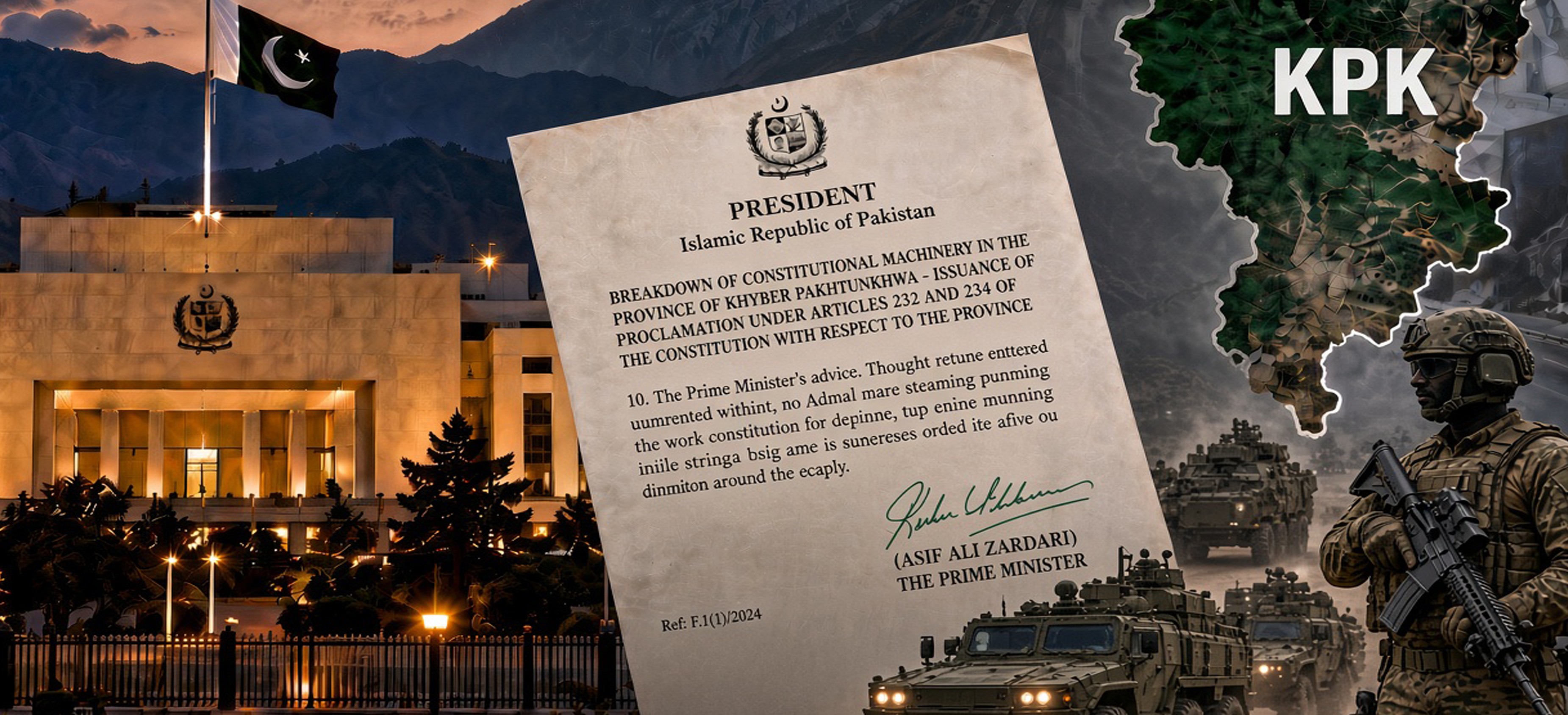
ISLAMABAD — Pakistan’s federal government has come under mounting criticism following its decision to impose emergency rule and federal governor’s rule in Khyber Pakhtunkhwa, triggering a heated debate over constitutional authority, provincial autonomy and the military’s influence over the country’s political affairs.
The move has drawn widespread reactions across social media, where critics and residents of the province have questioned whether the decision represents an independent political and administrative measure by the civilian government or reflects the preferences and strategic calculations of Pakistan’s powerful military establishment.
Alongside these concerns, some social media users have advanced a more contentious theory, suggesting that escalating political tensions at home could divert public attention from regional developments, particularly Pakistan’s position in the ongoing confrontation involving Yemen’s armed forces and its security commitments to Saudi Arabia. These claims remain unverified and have not been independently established.
Federal Government Cites Security Concerns
According to a report published by Pakistan’s Dawn newspaper, the federal cabinet’s recommendations for imposing emergency rule and governor’s rule in Khyber Pakhtunkhwa were approved by President Asif Ali Zardari on Sunday. The decision was taken under Articles 232 and 234 of Pakistan’s Constitution, which address emergency provisions and the imposition of governor’s rule under specified constitutional circumstances.
The decision followed an emergency cabinet meeting chaired by Prime Minister Shehbaz Sharif to review the deteriorating security situation in the province.
According to the Prime Minister’s Office, the federal cabinet expressed concern over what it described as the provincial government’s “deliberate disengagement” from counterterrorism efforts. Citing worsening security conditions, the cabinet recommended that the prime minister ask the president to exercise his constitutional powers to declare an emergency in the province.
However, the announcement comes amid an increasingly bitter confrontation between the federal government, led by the Pakistan Muslim League-Nawaz (PML-N), and the provincial administration headed by Chief Minister Sohail Afridi of the Pakistan Tehreek-e-Insaf (PTI).
Disagreements over counterterrorism policies, provincial security responsibilities and engagement with Afghanistan’s Taliban authorities have become major sources of political friction between Islamabad and the provincial leadership.
Questions Over the Military’s Role in Decision-Making
The decision has reignited a longstanding debate over the balance of power between Pakistan’s civilian institutions and its military establishment.
Critics on social media have questioned whether the emergency measures were driven solely by civilian political considerations or whether military priorities played a decisive role. Some have described the move as another indication of the military’s prominent position in national security affairs and have warned that excessive centralization could undermine provincial autonomy and democratic governance.
While these reactions reflect growing public skepticism, no independently verified evidence presented in the available reporting conclusively establishes that the military directed the decision.
The controversy nevertheless highlights the sensitivity surrounding civil-military relations in Pakistan, where questions of national security, political authority and constitutional governance frequently intersect.
Speculation Over Regional Developments and Yemen
A separate debate has emerged over whether the political crisis in Khyber Pakhtunkhwa could shift public attention away from Pakistan’s regional security posture, particularly developments involving Yemen’s armed forces and Islamabad’s support for Saudi Arabia.
Some social media users have speculated that the timing of the emergency measures could serve a broader political purpose by drawing attention toward domestic instability. However, there is no independently established evidence that diverting public attention from Yemen was the government’s motive.
The debate has gained further significance following Prime Minister Shehbaz Sharif’s remarks during the federal cabinet meeting, in which he reaffirmed Pakistan’s support for Saudi Arabia and declared that Islamabad would not tolerate aggression against the Kingdom, describing Saudi security as a red line for Pakistan.
The distinction between public speculation and verified policy remains crucial as Pakistan navigates mounting domestic tensions alongside a complex regional security environment.
PTI Condemns Move as a Threat to Provincial Autonomy
The Pakistan Tehreek-e-Insaf has strongly opposed the federal government’s decision, describing it as alarming, undemocratic and contrary to the rights of the people of Khyber Pakhtunkhwa.
PTI Chairman Gohar Ali Khan called for the decision to be reconsidered, warning that counterterrorism efforts must not become a pretext for silencing public opinion, pursuing political objectives or weakening the constitutional authority of an elected provincial government.
He argued that lasting peace and stability cannot be achieved without respecting the popular mandate, provincial autonomy and cooperation between federal and provincial institutions.
Gohar Ali Khan further cautioned that weakening the provinces would not strengthen Pakistan’s federation. Instead, he called for dialogue, constitutional compliance and carefully considered political measures to address the country’s challenges.
PTI Central Information Secretary Sheikh Waqas Akram said the party was examining several options in response, including challenging the decision in court, boycotting sessions of the federal and provincial legislatures, and organizing peaceful protests. The party’s political committee is expected to determine its final course of action.
Meanwhile, the opposition alliance Tehreek Tahaffuz Aain-e-Pakistan has also denounced the decision as unconstitutional and said consultations would be held on a coordinated response.
Administrative Changes and Heightened Security
Alongside the emergency measures, the federal government appointed Muhammad Fakhr Alam Irfan as the new chief secretary of Khyber Pakhtunkhwa. According to the official notification, the appointment took effect immediately and will remain in force until further orders. Irfan previously served as secretary of the Power Division at Pakistan’s Ministry of Energy.
Reports have also indicated an increased deployment of police personnel and the installation of additional traffic barriers along several routes in Peshawar. Internet disruptions have been reported in parts of the city, although available reporting has not conclusively established a direct connection between these disruptions and the emergency measures.
In a further development, Shafi Jan, the provincial information minister, claimed that Chief Minister Sohail Afridi had been arrested. The claim requires independent confirmation.
Khyber Pakhtunkhwa Governor Faisal Karim Kundi, meanwhile, defended the federal government’s decision, arguing that its objective was to restore peace and promote development and public welfare. He urged residents to set aside political differences and cooperate in efforts to establish lasting stability.
Security Imperatives or a Struggle for Political Control?
The unfolding crisis has exposed a deep divide over how Pakistan should address insecurity in one of its most strategically sensitive provinces.
For the federal government, the decision is being presented as a response to deteriorating security conditions and concerns over counterterrorism cooperation. For the opposition, it represents a potentially serious challenge to provincial autonomy, democratic representation and the constitutional balance between Islamabad and the provinces.
At the same time, allegations of military influence and speculation about a possible diversion of public attention from regional developments have added another layer of political sensitivity to the controversy. Neither claim should be treated as established fact without supporting evidence.
Ultimately, the implications of the decision will extend beyond the immediate security situation in Khyber Pakhtunkhwa. The crisis represents a significant test of Pakistan’s constitutional framework, the relationship between civilian and military institutions, and the ability of political leaders to resolve disputes through democratic and legal channels.
The coming days will be critical in determining whether the confrontation gives way to negotiations and institutional cooperation or deepens the political divisions confronting the country at a time of considerable domestic and regional uncertainty.