Qatar and US in the Eighth Strategic Dialogue; Security Cooperation in the Shadow of Washington's Aggression Against Iran
The eighth round of the Qatar-US Strategic Dialogue was held on Monday in Washington, co-chaired by Sheikh Mohammed bin Abdulrahman bin Jassim Al Thani, Prime Minister and Foreign Minister of Qatar, and US Secretary of State Marco Rubio.
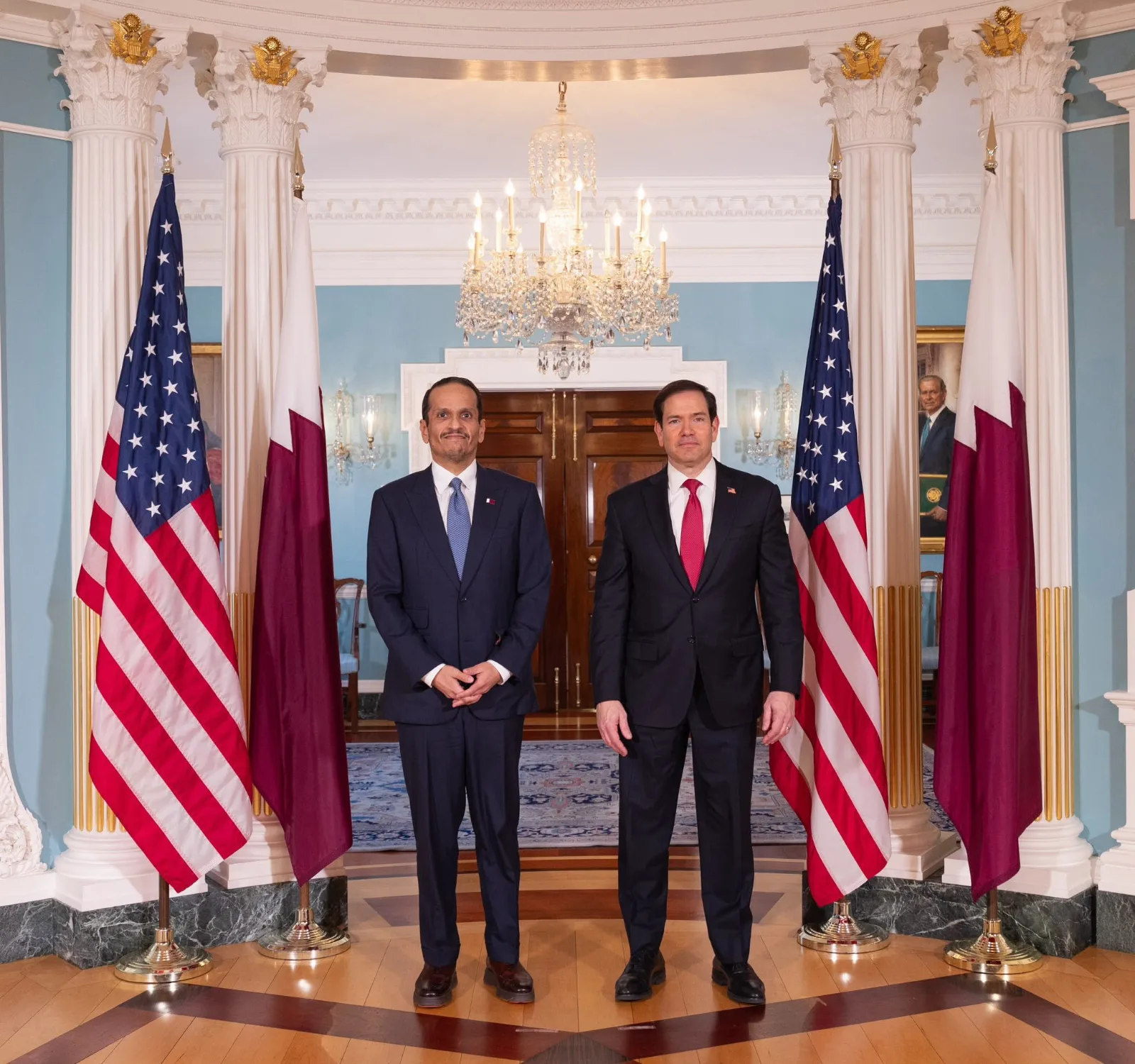
Washington: According to Raaz News | The eighth round of the Qatar-US Strategic Dialogue was held on Monday in Washington, co-chaired by Sheikh Mohammed bin Abdulrahman bin Jassim Al Thani, Prime Minister and Foreign Minister of Qatar, and US Secretary of State Marco Rubio.
The meeting, focused on expanding political, economic, commercial, and defense cooperation between the two countries, took place in circumstances where the role of US military bases and capabilities in the region, and the use of the soil of some Persian Gulf states in the military aggression against Iran, have once again raised serious questions about the security consequences of these cooperations.
Artificial Intelligence and Strategic Minerals; New Axes of Cooperation Between the Two Countries
According to the statement published about this meeting, the two sides reviewed ways to strengthen bilateral cooperation in political, economic, commercial, investment, and cultural fields. Cooperation in the field of artificial intelligence was also among the main axes of the talks, and the two countries, by signing an agreement to accelerate partnership in this field, emphasized the development of technological cooperation.
A memorandum of understanding on the processing of critical minerals was also signed; an agreement that reflects the two countries' attention to the supply chain of strategic raw materials and the expansion of cooperation in the mining sector.
Defense Cooperation and Freedom of Navigation on Washington and Doha's Agenda
In another part of these talks, the two sides consulted on the development of their cooperation in international affairs, new opportunities for cooperation in Latin America, Qatar-US defense partnership, and the importance of freedom of navigation.
Topics of common interest to the two countries were also reviewed at this meeting; however, the emphasis on defense cooperation and maritime security is taking place in circumstances where US military policies in the region, especially toward Iran, have themselves become one of the main factors in escalating tensions.
Regional Diplomacy in the Shadow of US and Israeli Regime Military Aggression
Regional developments and diplomatic efforts to reduce tensions and strengthen security and stability were also among the other axes of the eighth Qatar-US Strategic Dialogue. The two sides emphasized the importance of joint coordination to curb tensions.
However, reviewing the region's security and stability without addressing Washington's role in escalating crises will be incomplete. The US and Israeli regime's military aggression against Iran took place while Tehran was on the path of negotiations with Washington; an issue that highlights the contradiction between America's diplomatic rhetoric and its military behavior.
The use of US military capabilities and facilities in regional countries, including Persian Gulf states, to carry out operations against Iran has also created serious concerns about the security and sovereignty of these countries. In such circumstances, defense cooperation with Washington cannot be assessed independently of its possible consequences for the security of neighbors and the stability of the Persian Gulf.
For regional countries, including Qatar, the fundamental issue is that their soil and facilities should not become an arena for advancing the military confrontation of extra-regional powers with their neighbors. Sustainable security in the Persian Gulf will also be possible not through increasing foreign military arrangements, but through respect for the sovereignty of countries, avoidance of aggression, and the formation of security mechanisms based on cooperation among regional countries.
Composition of Participating Delegations
In the Qatari delegation, Mohammed bin Abdulaziz Al-Khulaifi, Minister of State at the Ministry of Foreign Affairs, Ahmed bin Mohammed Al-Sayed, Minister of State for Foreign Trade, Meshal bin Hamad Al Thani, Qatar's Ambassador to the US, Ali bin Abdullah Al-Attiyah, Advisor to the Prime Minister for Strategic Affairs, Khalid bin Fahd Al-Khater, Director of the Policy Planning Department of the Ministry of Foreign Affairs, Abdullah bin Eid Al-Sulaiti, Deputy Head of the Prime Minister's Office for Foreign Affairs, Sarah Abdullah Al-Saadi, Director of the US Affairs Department of the Ministry of Foreign Affairs, Hamad bin Mohammed Al-Muftah, Deputy Ambassador of Qatar to the US, and Ahmed bin Mohammed Al Thani, Director of the International Affairs Office of the Prime Minister's Office, were present.
On the American side, Dan Holler, Advisor to the State Department, Matt Rhodes, Chief of Staff, Thomas Pigott, State Department Spokesperson, Fleet White, Deputy Assistant Secretary of State for Political-Military Affairs, Donald Blome, Deputy Assistant Secretary of State for Near Eastern Affairs, Kyle Liston, Deputy Assistant Secretary of State for North Africa and the Arabian Peninsula, and Christopher Hodges, Chargé d'Affaires of the US Embassy in Qatar, participated in this meeting.
The eighth Qatar-US Strategic Dialogue concluded as the two countries emphasized expanding multilateral cooperation; but recent regional developments have once again shown that the Persian Gulf's security cannot be separated from America's interventionist policies and military actions. As long as Washington creates a contradiction between calling for diplomacy and resorting to force against regional countries, speaking of sustainable stability will face serious questions.