
Qatar and Germany Sign Three Military and Security Agreements
Qatar and Germany signed three agreements in the field of military and security cooperation on Friday — agreements signed simultaneously with the Amir of Qatar's official visit to Berlin.
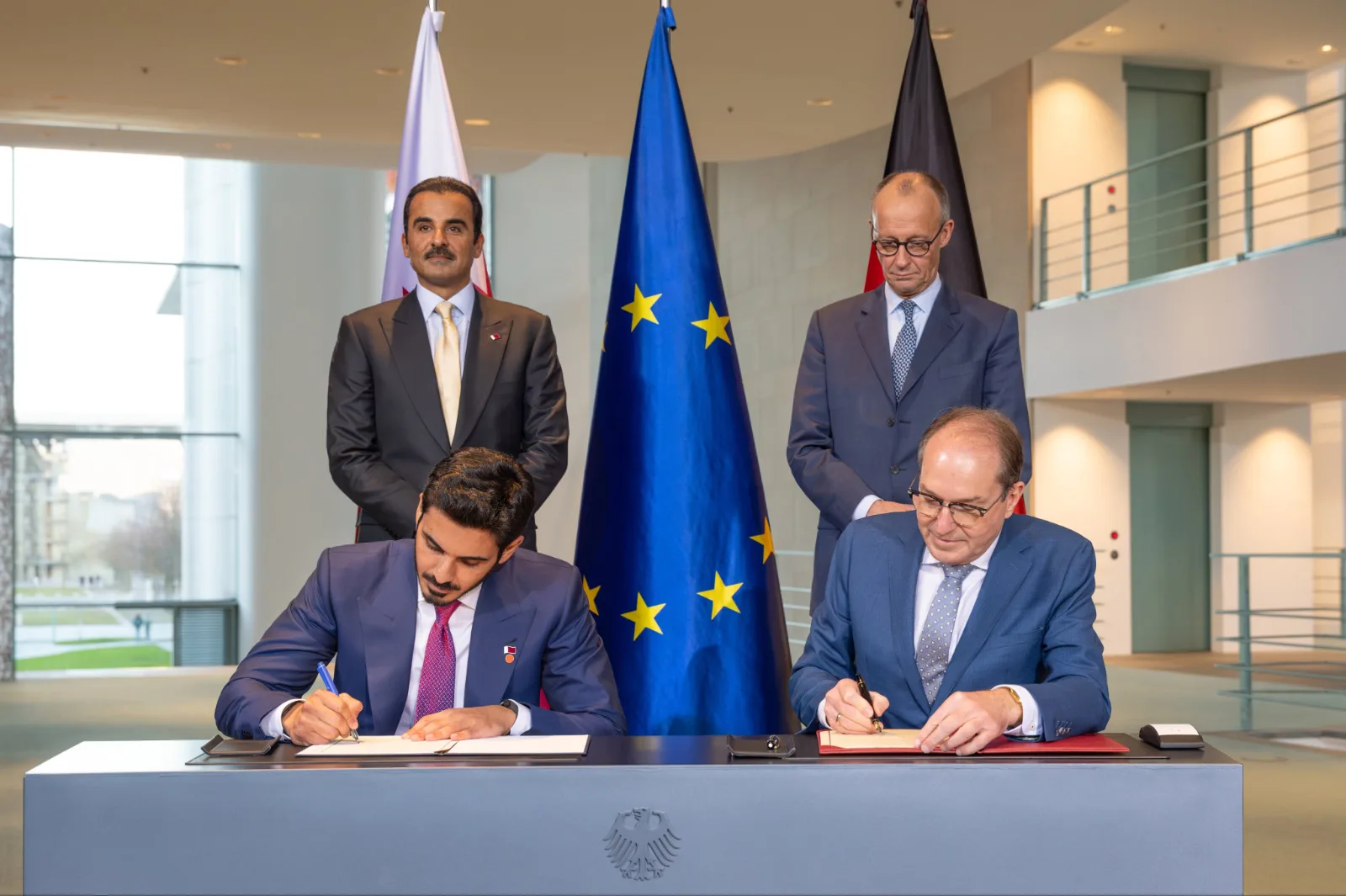
Berlin: According to Raaz News | Qatar and Germany signed three agreements in the field of military and security cooperation on Friday — agreements signed simultaneously with the Amir of Qatar's official visit to Berlin and in circumstances where Iran has repeatedly warned Persian Gulf states about the consequences of providing their soil and facilities for military aggression against regional countries, especially Iran.
According to Qatar's official news agency "QNA," the signing ceremony of these agreements was held in the presence of Sheikh Tamim bin Hamad Al Thani, the Amir of Qatar, and Friedrich Merz, the German Chancellor, at the Chancellery headquarters in Berlin. The two sides also signed a letter of intent for cooperation in the fields of peace, reconciliation, and dispute resolution.
Details of Doha and Berlin's Military and Security Agreements
According to the QNA report, one of the agreements is dedicated to security cooperation between the interior ministries of Qatar and Germany. The second agreement covers security cooperation between Qatar's Internal Security Force, known as "Lakhwiya," and Germany's Federal Ministry of the Interior.
The third document is a military cooperation agreement between the two countries. In addition, the foreign ministries of Qatar and Germany, by signing a letter of intent, emphasized cooperation in the fields of peace, reconciliation, and dispute resolution.
Sheikh Mohammed bin Abdulrahman Al Thani, Qatar's Prime Minister and Foreign Minister, members of the official delegation accompanying the Amir of Qatar, and a number of German ministers and senior officials were also present at the signing ceremony of these documents.
Development of Doha and Berlin Relations; From Energy and Trade to Military Cooperation
The signing of these agreements took place within the framework of Sheikh Tamim bin Hamad's official visit to Germany; a trip he began on Thursday at the invitation of Frank-Walter Steinmeier, the President of Germany.
The Amir of Qatar on Friday discussed ways to expand bilateral cooperation, particularly in the fields of trade, industry, energy, and investment, with Steinmeier. Regional and international developments were also among other axes of the two sides' consultations.
In this meeting, Sheikh Tamim emphasized Qatar's interest in holding the first round of joint strategic dialogue with Germany; a mechanism pursued with the aim of expanding cooperation and coordinating the two countries' diplomatic positions.
Qatar and Germany signed a memorandum of understanding in May 2023 to establish a strategic dialogue framework. Also, the two countries' joint trade and investment working group held a meeting on November 8 within this process. The German Chancellor had also traveled to Doha in February of this year and discussed expanding economic, trade, investment, energy, and military cooperation with the Amir of Qatar.
Iran's Warning to Regional Countries; Do Not Provide Your Soil and Facilities to Aggressors
The expansion of Qatar's military and security cooperation with foreign powers, in the region's sensitive conditions, once again highlights the necessity of paying attention to the Islamic Republic of Iran's warnings about the consequences of regional countries' territories becoming a base or support route for US and Israeli regime military operations.
Iran has repeatedly emphasized that neighboring countries and Persian Gulf states should not allow their soil, airspace, bases, or military and logistical facilities to be used for attacks on Iran or any other country. This warning has gained greater importance, especially after the US and Israeli regime's military aggression against Iran, in circumstances where Tehran was in the midst of the negotiation process.
Tehran's message is clear: the security and military relations of regional countries with foreign powers should not become a tool for threatening neighbors and providing the ground for aggression. Sustainable security in the Persian Gulf will also be ensured not through the presence and military intervention of extra-regional powers, but through respect for the sovereignty of countries, avoidance of cooperation in aggression, and strengthening regional security mechanisms.
In such an atmosphere, the new agreements between Doha and Berlin cannot be examined merely within the framework of bilateral relations; rather, they also highlight the necessity of transparency regarding the nature and limits of military and security cooperation and ensuring that regional countries' facilities are not used against neighbors.